Data nobody listed
“Every quarter in my last enterprise role, I would have sworn I knew where our sensitive data was. Every quarter, the audit found something new.” Dipal Panchal, CEO
Data security governance
IRIS shows what sensitive data you have, who can reach it and where protection is missing. After your team’s fix, a re-scan shows whether the state changed.


4
paid engagements
3
proofs of concept
100+
years of combined experience
In data, security and enterprise technology, across the team
IRIS answers four questions in order: what sensitive data you have, who can reach it, where protection is missing, and whether the fix changed the result.
First scan: what IRIS records
Re-scan: the new state
“Every quarter in my last enterprise role, I would have sworn I knew where our sensitive data was. Every quarter, the audit found something new.” Dipal Panchal, CEO
Shared service accounts and permissions granted for one project still work after it ends, and nobody has reviewed them since.
A closed ticket isn’t proof that the risk changed. A successful re-scan is.
What sensitive data you have, and where
Who can reach it
Whether it’s protected, so your team can close the gaps
Whether the fix changed the observed state
Mark the accounts your AI tools use, and IRIS shows what data they can reach.
Your team marks the accounts your AI tools use. IRIS shows the sensitive data each one can reach and flags admin rights and broad access. It doesn’t read prompts or outputs.
Before you switch on an AI assistant, find sensitive files in Microsoft 365 shared through public links or broad groups.
Scan the store a dataset lives in to see what sensitive data it holds, and check its sampled values for encryption, masking or hashing.
The table follows six findings through the same sequence, from the first scan to the re-scan after a fix.
Choose sources; gaps are recorded
Read-only where the source allows; each tested
Classify, map access, check protection
Approve or decline; a decline needs a reason
Export, fix, re-scan
Re-scan after a fixRe-scan after a fix| Data type | Where | Who can access | Found | After the fix and re-scan |
|---|---|---|---|---|
| Email address | AWS S3 · customer-exports | Support, Finance | Not protected | Masked |
| Passport number | Microsoft 365 · HR folder | HR team, all staff | Excessive access | Access removed |
| Card number | PostgreSQL · billing | billing-svc (service account) | Not protected | Encrypted |
| National ID | Google Workspace · onboarding | Anyone with the link | Shared by link | Link removed |
| Card number (candidate) | PostgreSQL · orders | Not assessed | Rejected by the reviewer: order numbers that pass Luhn by chance | No action needed |
| Not classified | Microsoft 365 · payroll folder | Not assessed | Not read: the file is password-protected | Listed as a gap until it’s readable |
Every record carries its scan date, and a re-scan adds the new state beside the old one.
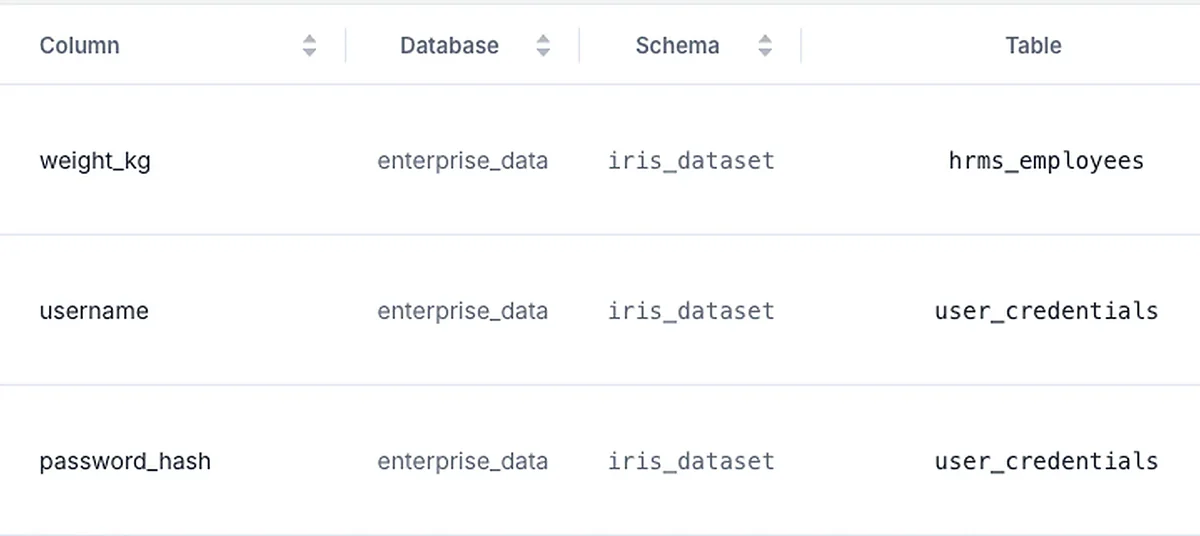
Sensitive data by source, schema, table and column, with the source recorded for each finding. Each one carries a confidence level and a review status for your reviewers to check.
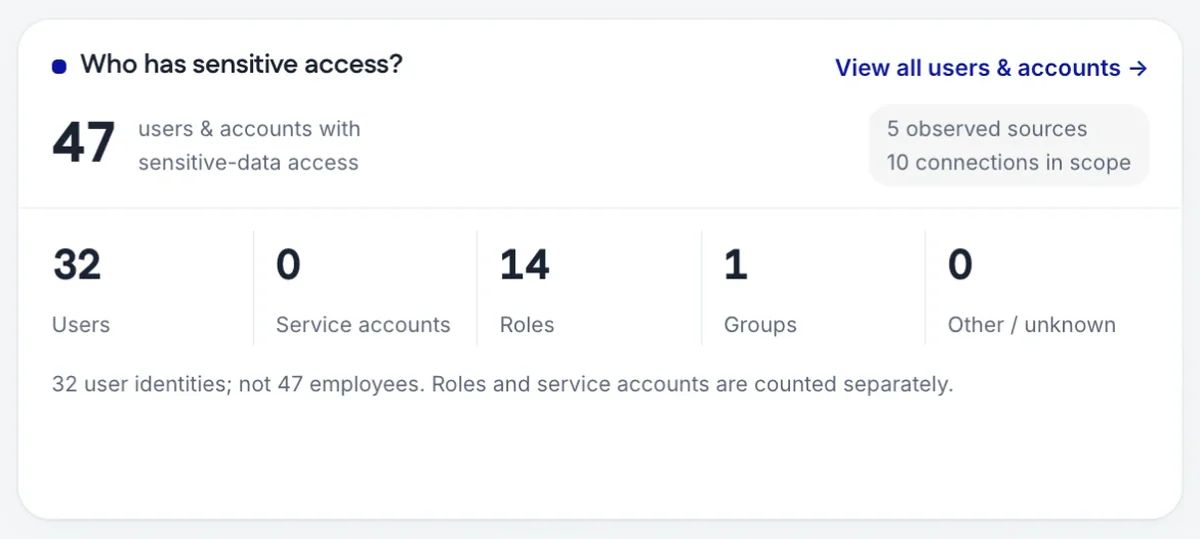
Excessive access is flagged, and stale access where the source records activity. On PostgreSQL, activity is tracked per database account unless audit logging is turned on.
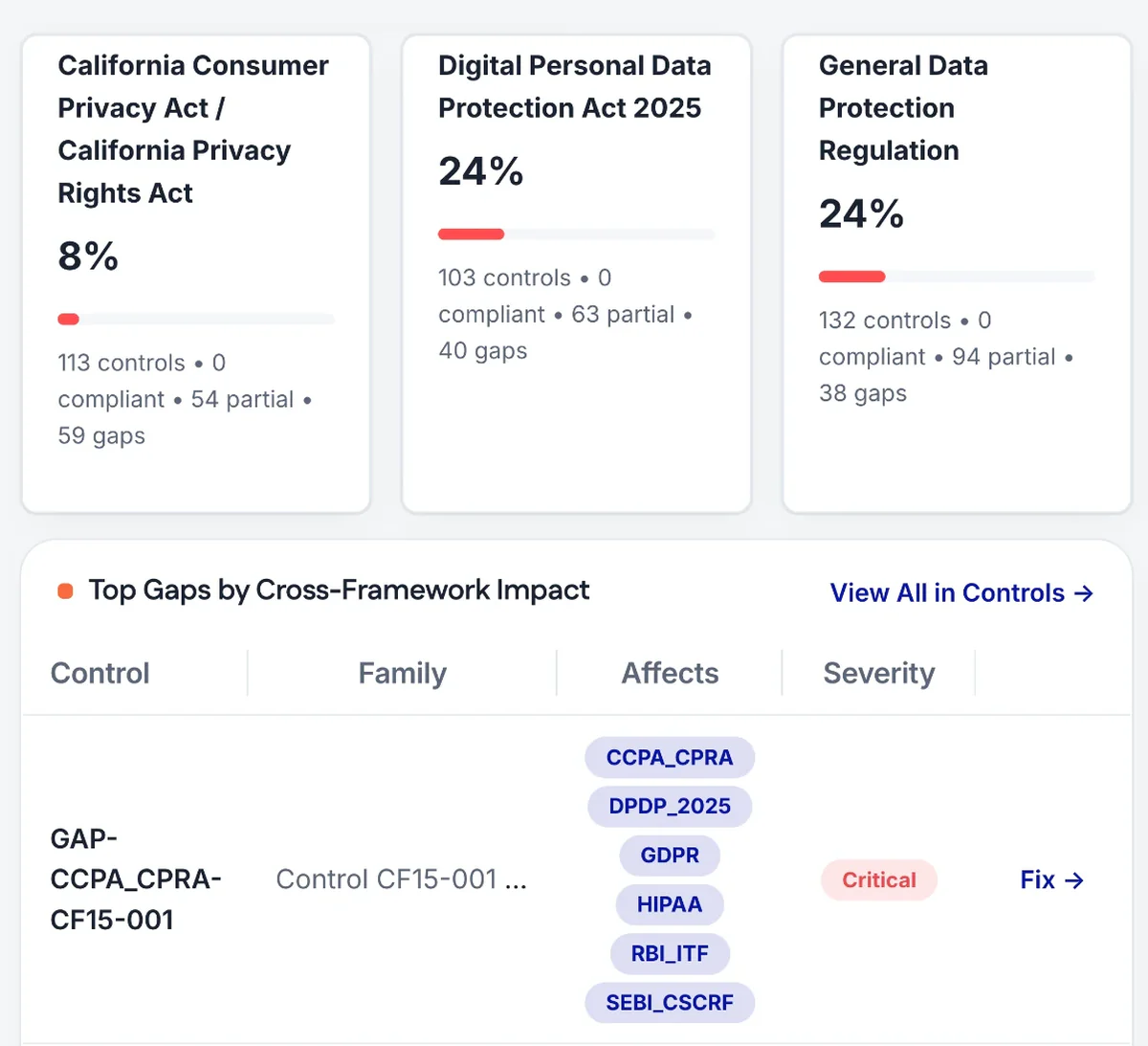
Findings mapped to controls, for your team to review and share with an auditor, a regulator or a customer. Every scan is dated, and a re-scan records what changed.
Applies to IRIS v1; checked November 8, 2026. Coverage differs by source; we confirm what IRIS can read before any scan. Capabilities vary by edition.
12
database and warehouse engines
Including PostgreSQL, SQL Server, Oracle, Snowflake and SAP HANA
103
built-in data types
Global, US and Indian formats, from IBAN to NPI and Aadhaar
15 min*
to scan a structured source
373
controls in one unified framework
Mapping shows relevance; your auditors judge whether a control is met.
*About 100 tables, reading a sample of each table. Time depends on the number of tables and columns, not table size.
IRIS can be deployed in your own infrastructure, on-premises or in any cloud, so your data stays within your environment.
Sources you connect
Your environment
Outbound connections
See what was assessed, what was missed, what’s exposed and what you can defend.
A source-linked record of the sensitive data you hold and where it sits, refreshed with each scan.
Audit the data itself, not only the spreadsheet describing it.
Read-only accounts where the source offers them, deployable in your environment, agentless where the source supports it.
Six frameworks mapped through one unified control framework, from GDPR and HIPAA to India’s DPDP Act and SEBI CSCRF.
The chips link to our law guides. For UK GDPR, UAE PDPL and Saudi PDPL, IRIS produces evidence that supports your assessment; a dedicated pack isn’t available today.
Four situations where a copy sits outside the inventory, and what a scan of the connected sources shows in each.
Branch teams scan bills of lading, customs papers and driver documents into shared folders. Each branch names them differently, and nobody keeps a list.
Text recognition reads the scanned PDFs and images in connected drives and cloud storage, and files it couldn’t read are listed with the reason.
Teams remove names from a patient extract before reuse, but dates of birth, postal codes and rare diagnoses can still point to one person.
IRIS lists the sensitive fields left in the extract, column by column, so the team can decide what else to remove.
Full claim files go to medical reviewers and payment processors, though each one needs only part of the file.
The claims owner sees which sensitive fields sit in the claims source and the partner exchange folder, and agrees a field list for each partner.
Consultants copy a client’s HR extract into a project workspace for an analysis. When the project ends, the extract stays.
A scan of the connected workspace finds the extract, its sensitive fields and who can reach it.

What an evidence record holds: scope, findings, gaps and dates.
Data security governance and management, and where it goes beyond posture management.
Watch IRIS at work, from connected sources to evidence.
IRIS finds sensitive data in the supported sources you connect, shows who can reach it where permission evidence is available, and checks whether it’s protected. It also produces source-linked evidence you can put in front of an auditor, a regulator or a customer’s security team.
That the sampled values and access IRIS can read now show a different state, with the scan date. It doesn’t show that the whole risk is gone, or what happened between the two scans.
No. IRIS scans at a point in time, on a schedule you set or when you run one. Every scan is dated, and you can re-scan to record what changed.
It flags and records. Your team makes the change in the source system, such as removing access or masking a column, and a re-scan records the new condition.
Yes, for the accounts your team marks as used by AI. IRIS shows the sensitive data they can reach and checks whether it’s protected. It doesn’t read prompts or outputs.
The architecture page lists each connection that leaves your network, and the trust page dates each security item, including certification and where classification runs. We answer your security questionnaire during scoping.
Start with a free assessment of the one database your auditor asks about most, or book a demo.